









Carbon Sinks
Afforestation
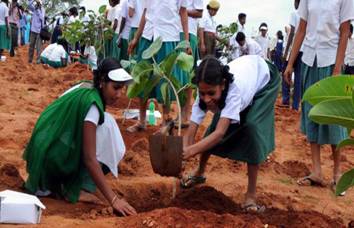
Afforestation refers to the process of transforming non-forest land into forested areas through systematic tree planting and ecological restoration. It is recognized globally as an essential strategy for sustainable development, biodiversity conservation and climate-change mitigation. The rapid expansion of infrastructure, industrial activity and urbanization has historically resulted in extensive loss of natural forest cover, thereby weakening ecosystem services and reducing the capacity of terrestrial landscapes to act as effective carbon sinks.
Afforestation programmes help counter the impacts of deforestation, soil degradation, habitat loss, air pollution and global warming. By expanding forested areas, the process contributes to long-term ecological balance, supports hydrological cycles and promotes the restoration of degraded landscapes.
Status in India
India continues to be among the world’s largest contributors to land-based carbon sinks. According to the India State of Forest Report (ISFR) 2023 and provisional data for 2025:
- India has an estimated forest and tree cover of approximately 25.4% of its total geographical area, reflecting a gradual but steady increase from previous decades.
- The total forest and tree cover stands at around 83.5 million hectares (2025 estimate), an improvement over the 2013 figure of 76.87 million hectares.
- National carbon stock in forests has continued to expand, reaching an estimated 7,350–7,400 million tonnes of carbon by 2025, representing an increase of roughly 6–7% since 2013.
Forests act as major carbon sinks by absorbing atmospheric carbon dioxide and storing it in biomass—trees, foliage, litter, roots—and in the soil. When forests are cleared, degraded or burned, stored carbon is released back into the atmosphere, contributing to rising greenhouse-gas concentrations. Conversely, expanded forest cover and well-managed afforestation efforts enhance sequestration and help moderate regional and global climate patterns.
Climate change continues to influence forest ecosystems, affecting species composition, productivity and distribution. Some regions may experience increased vulnerability due to heat stress, drought and pests, while others may witness enhanced vegetation growth. Nevertheless, forests remain central to India’s climate-mitigation strategy under its Nationally Determined Contributions (NDCs), particularly the commitment to create an additional 2.5 to 3 billion tonnes of CO₂ equivalent through forest- and tree-cover restoration.
Sustainable Forestry Management (SFM)
Sustainable Forest Management (SFM) is an integrated approach that aims to balance ecological, economic, social and cultural objectives while maintaining forest health and productivity for present and future generations. As emphasized by the United Nations (1992), SFM addresses both the causes and consequences of deforestation and forest degradation and strengthens the role of forests in supporting livelihoods, biodiversity and climate stability.
SFM frameworks are built on policy, legal and institutional mechanisms supported by scientific planning, financial incentives, modern technology and skilled human resources. These frameworks promote conservation, responsible use of forest products, protection of ecological functions and long-term landscape resilience.

Key Functions of SFM
- Enhanced forest productivity: Promotes sustainable harvesting, expanded value chains and increased availability of timber, fuelwood, NTFPs (non-timber forest products) and other forest goods.
- Natural disaster mitigation: Reduces risks from forest fires, pest outbreaks, floods and landslides through active management and monitoring.
- Carbon sequestration: Strengthens natural carbon capture mechanisms by improving forest density, promoting agroforestry, expanding tree-based land use and enhancing soil carbon retention.
- Water ecosystem services: Forest catchments continue to provide approximately 70–75% of India’s freshwater supply, acting as natural regulators of hydrology, groundwater recharge and water quality.
Current Forest Classification and Carbon Stock (India 2025)
Based on ISFR trends and updated assessments:
- Very Dense Forest: ~86,000 sq. km
- Moderately Dense Forest: ~314,000 sq. km
- Open Forest: ~301,000 sq. km
- Total forest cover: ~701,000 sq. km
- Estimated carbon stock: ~7,350–7,400 million tonnes (2025)
These figures indicate relative stability in dense forest categories, with incremental increases in moderately dense forests largely due to restoration programmes and agroforestry expansion.
Institutional and Policy Framework in India
National Afforestation and Eco-Development Board (NAEB)
Established under the Ministry of Environment, Forest and Climate Change (MoEFCC) in 1992, NAEB continues to coordinate afforestation, ecological restoration and eco-development initiatives across the country. As of 2025, NAEB programmes increasingly focus on:
- Restoration of degraded forestlands.
- Rejuvenation of forest-fringe villages.
- Landscape-level restoration in ecologically fragile zones such as the Western Ghats, Eastern Himalayas, Aravalli ranges, and drought-prone regions.
- Community-based forest management and livelihood enhancement.
Key Government Initiatives Supporting SFM (Updated to 2025)
- Forest (Conservation) Act, 1980 (amended 2023): Strengthens regulatory oversight for diversion of forest land and includes provisions for ecological safeguards, compensatory afforestation and post-approval monitoring.
- National Forest Policy, 1988 (revision under consultation as of 2025): Reinforces the goal of achieving 33% national forest and tree cover, with a stronger emphasis on climate resilience, biodiversity protection and community forestry.
- Joint Forest Management (JFM): Continues to involve local communities in forest protection, benefiting around 20 million people in forest-fringe areas.
- National Forestry Council (NFC): Provides strategic oversight across states for implementing forestry missions.
- Compensatory Afforestation Fund Management and Planning Authority (CAMPA): Manages the utilization of more than ₹60,000 crore in afforestation and regeneration funds as of 2025, enabling large-scale plantation, monitoring and forest-quality enhancement.
- Green India Mission (GIM): One of India’s eight missions under the National Action Plan on Climate Change (NAPCC), focusing on improving ecosystem services, increasing forest cover, and enhancing carbon sinks.
- Agroforestry Policy (2014 and updated 2023): Expands tree-based farming, promoting species diversification, farmer incentives and integration with carbon-market opportunities emerging after 2023.